Thanks to funding from the Institute of Museum and Library Services, the OSAC is preserving and digitizing the collection's valuable mite collection. The earliest components of the OSU mite collection date back to the early 1900's but the vast majority of the collection was amassed through the research and curatorial efforts of Dr. Gerald Krantz, who began working at Oregon State University in the 1950's and continues to conduct and publish his acarological research as emeritus faculty.
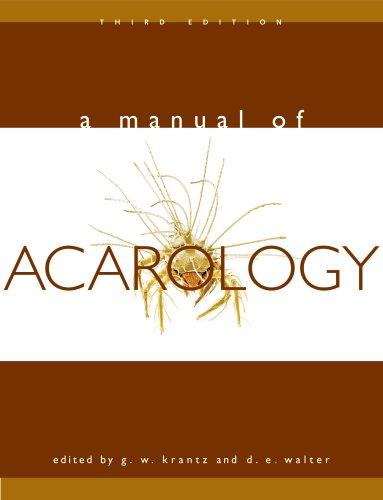
The mite collection is global in scope and has valuable material in the form of type specimens as well as voucher material for many of Dr. Krantz' and others publications. Most notably, the mites in this collection formed a large basis for the illustrations used in making the Manual of Acarology. This work, first published in 1970, is now in its third edition and is a definitive guide to the world's mite fauna. Through its identification keys and illustrations, a student or researcher of acaraology can successfully identify nearly any adult mite to its appropriate family, and thereby access more literature and resources so as to identify it further.
The scope of this project is multi-facetted.
The primary objective for this project is to conserve the link between specimens and their biological data by ensuring that the labels are securely fixed to the glass microscope slides. The glue/adhesive used for many of the labels has become brittle with age and has begun to 'pop' off the glass surface of the slides. It's imperative that these labels be re-affixed to their corresponding slides. We are also replacing the mis-matched faulty slide boxes with new, standard, slide boxes.
OSAC mite collection catalog
The second goal of the IMLS funded project is to make the collection far more accessible. We are doing this in a variety of ways. First, the project itself is raising awareness of the mite collection (and mites themselves) with the student workers who are hired to assist in this project. This includes students who are physically on campus, but also e-Campus students who are enrolled in OSU's online learning environment.
This is the first time the collection has had an opportunity to engage online students directly in the curatorial mission of the collection.
However the accessibility of the mite collection is being extended far further via two related digital products: (1) the first ever complete catalog of the mite collection itself, and (2) images of the slides, along with their labels.
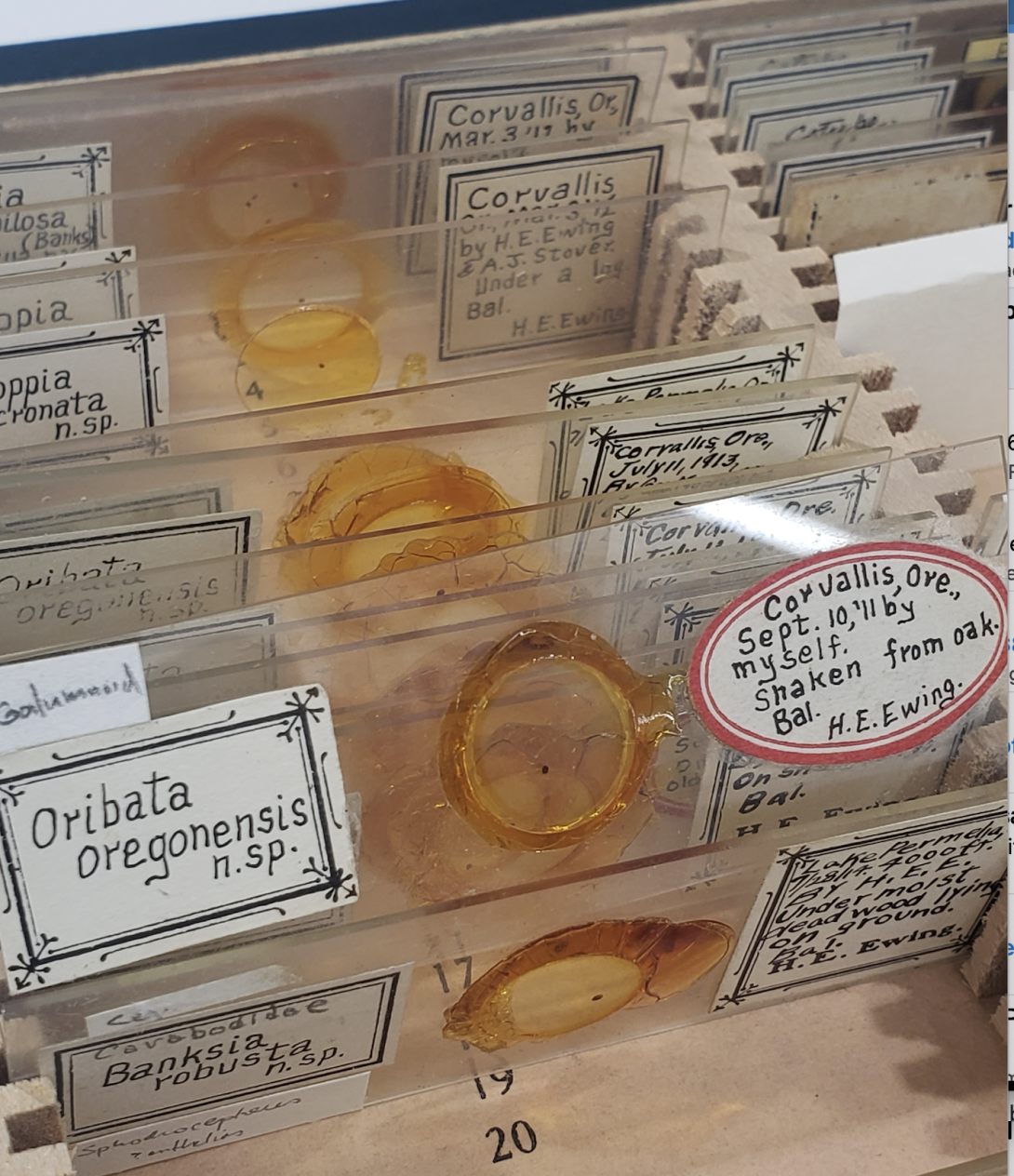
Individual slides are digitally photographed. In most cases the digital image of the slide is not of high enough resolution to see details of the mite specimen(s). However, they do provide researchers the capacity to examine the slide label data directly. For certain specimens, e.g, holotypes, higher resolution images of the specimen itself will be added to the specimen record.